Saturday, June 26, 2010

Radio Drama

Sorry about 2 posts in 2 days, but here goes!

I sat in harbor this morning waiting for the tide to turn and pondered the upcoming week.  Much rides on our ability to select the right location to fish during the main King opener at 12:01am, July 1.  Fish and Game predicts a 6-10 day opener, but it could be more or less, depending upon the amount of fish caught.  

I had the charts out, trying to divine some inspiration about the best place to fish, with places to run in bad weather and possible anchorages for the night.  My morale is at an all-time low for some reason – gray, windy, endless rainy weather and slow fishing, as well as an empty bank account with bills coming has depleted my normal reserves of optimism.  I am having doubts about my ability to perform in the crunch – I keep getting encouragement from various sources, but it really boils down to me, and sometimes that’s brutally depressing!  

It’s Saturday, and the sport and charter boys are out in force.  I heard them all leaving the harbor at 6 this morning – after a dry run fishing till 9pm last night, I had no desire to leave that early.  Only a couple of other trollers seemed hungry enough to venture out today, so I sat and pondered.  And pondered.  Weird word, ponder. 

As I dRadiosid so, I had the VHF on channel 16, which we monitor all the time as it is the primary contact channel.  Suddenly a male voice,  high pitched with stress, was yelling “Mayday! Mayday! 17 foot skiff somewhere north of Hanus Point, taking on water!”  Several vessels in the area answered, and the fragments of spotty radio transmission painted the picture – a skiff, with 2 people on board, had engine trouble and was getting slopped around in the seas, taking on lots of water.  They were unable to transmit GPS coordinates,  and had only a vague idea of their true location.  After a couple of minutes, the transmissions ceased.

The Rocks

The radio came alive with boats heading for the general area – from the various descriptions floating around, it was about a 3 square mile area that they could be in.  I sat and listened to the conversations – guys searching north, south, in the bays, and no sightings, no transmissions.  The wind and rain in my rigging heightened the sense of urgency – 10 minutes, 20 minutes, 1 hour, and nothing.  It was easy to picture the worst – no power, wind pushing water over the stern, radio and electronics swamped, low visibility conditions – were they able to bail?  Did it sink?  Was the engine going again with just their radio dead?  The Coast Guard helicopter arrived at the approximate coordinates and acted as communication coordinator between the searching boats.  A box search was implemented, with Peisar Island as the center.  No word.

After about an hour, a charter boat called in, somewhat north of the anticipated area.  They had found the skiff, and made contact.  The skiff had lost power, swamped, drowned all the electronics so no contact could be made, but had stayed afloat.  They were able to sort out the engine problem and get started again, and were running back toward home and calmer water.  The charter boat let them talk to the Coast Guard helo, and they confirmed their intention to head for home.  The State Trooper boat from Sitka made contact and began the escort home.  I just heard the troopers call in that the skiff was safely entering Sealing Cove, where I live, so I ran out and snapped the picture of the “alleged” fishermen and their skiff as they cruised by.  Little Skiff, Big Ocean   All’s well that ends well, but somehow the whole incident just added another twist in my gut.  I wish my imagination wasn’t so active.  And I really don’t like the singing of the wind in the rigging right now.

Another day on the waterfront…

Friday, June 25, 2010

Finally – Catching!

Well, the week was productive at last!  We are still in the hatchery openings prior to the big July king opener, so we are assigned areas we can fish for just a couple of days a week.  We can’t go roaming all over, but I went out in what is called the “Western Channel” which was open Monday and Tuesday of this week.  I had heard rumors of fish moving in from the open ocean along the far side of the Sound, and wanted to try the area.  It’s about 2 hours across in my boat, so I was out at 4am and fished my way over, following the boundary line as we all seem to do.  That took about three and a half hours, just putt-putting along with not a single nibble in the moderate swell that rolled in from the outside waters.   RADIO at Liar's Rock I finally passed Vitskari Rocks, one of the boundary points for the area, and followed the undersea terrain to the north, trying to entice some fresh sea-run king to take my bait.  The wind began to stack the swell into a bit of a chop, typical for the Sound, but nothing to be concerned over.  As the 7 other boats in the area plodded along on similar quests in a similar pattern, the time seemed to stretch boringly into eternity.  I looked at the tide table, and saw that the tide had just gone slack and was starting to come back in.  Suddenly, my port heavy line gave some big tugs, a sure sign that something had just grabbed a hook.

I went out to the pit, leaving the boat on autopilot, and transferred control to the rear console.  I have an autopilot control, a depth sounder, and a flat screen for seeing the GPS/Nobeltec chart plotter program while working in the pit, as well as a handheld VHF in case I get in trouble back there.   There is a throttle and hand steering wheel also, so I can do everything except put the boat in forward or reverse from the pit.  There is a good deal of time spent in the rear while checking gear, so you have to be able to do everything from there while fishing alone.Sea Otter in kelp

Sure enough, up came a bright, beautiful 15 pounder up to be conked in the head, gaffed, and heaved aboard.  We conk them on the head before gaffing and heaving them aboard so that they don’t flop all about, bruising the meat and knocking their scales off, as well as slinging blood all over the place and getting tangled in all the lures and fishing lines in the work area.  I made the mistake of not whacking one I was afraid was too loosely hooked, and boy did he make a mess!

I put the gear back in, and went back to the pilot house.  I had barely sat down when wham!  Lines jangling away again, and another fish on!  I excitedly crawled back in the pit, and began pulling the line in.  A very nice fish, probably 20 pounds, was vigorously fighting on the line.  I tentatively pulled him hand over hand toward the boat, and got him in place for whacking.  He kept twisting away at the last minute, so I took my time.  Finally, he was positioned right, and I whacked.  It was a glancing blow, just enough to excite him, and he took off again.  I worked him back in place, and decided to whack again to tame him down.  Whack! The line broke right at the hook, and he swam away.  I was depressed, to say the least! 

Dejected, I put the gear back out, and went inside mumbling to myself – ok, maybe it was out loud, I have been alone for a long time! Ninety dollars worth of fish, gone.  Depression faded in a flash as the lines began to go wild again!  This time, it was an even larger fish, 26 pounds(after being cleaned), and I was able to cleanly conk and gaff after about a 10 minute fight.  Blues begone!FreshFish

The same thing continued until I had 4 nice fish on ice, and then I looked around.  The weather was just getting yucky, the kind that just makes you tired from the continuous banging around, and no other boats were in sight.  I pointed myself back across the Sound, and 2 hours later was finally back in port.  

A very similar pattern on Tuesday, with 5 fish landed, none lost.  I caught all of them in about a 30 minute period, so I was busy cleaning for a while.  I just had the boat on autopilot, pointed north to keep me in the most agreeable position to work in, and kept my lines in the water.  When completed, I noticed my port stabilizer was riding really close to the boat.  I realized I had come across one of the scourges of the sea, the dreaded kelp monster!  There is a great deal of kelp growing in the bays and inlets of the area, and they float hither and yon as the tides move.  Generally one tries to maneuver around them, as they can be a real pain, but there is almost always some that gets wrapped around the gear during the course of a day.  If you get a really big one, it can seriously impair your ability to change directions or retrieve your gear.  Today, I had one!

I pulled the rest of the gear in to simplify the situation, and began trying to get rid of the kelp.  I was able to pull the wad up close to the boat, and began to slash.  After a long, sweaty battle, the stabilizer was freed.  Then, the work began to free the one remaining stainless trolling line.  The hydraulics were only able to get it near, but not  enough to pull it thru.  A few dicey minutes of feathering the hydraulics, putting on the brake, leaning as far as I could, cutting , breaking a knife,  finding another, and so on, I finally was free!  I pulled it all in, and headed for home.  HomewardBound

After unloading at the fish buyers, I finally cooked my supper in harbor at 11pm and went to bed, exhausted.  Lots of hours for 8 fish!  Prices have dropped, also, pending the summer opener.  Glad I didn’t have too many illusions about getting rich the easy way, or even getting rich!  If I could just make enough to pay the bills, that would be nice!  I’m beginning to wonder…. gotta give it the best effort that I have in me this year, and see where we wind up.  If you start to see a DONATE button on this site, you’ll get the idea of how things are!  Still not ready to trade it for my office job yet…

Fish on.

Friday, June 18, 2010

Cleanup Time!

Well, we’ve done a lot to the boat on the inside, engine, topsides, gear, rigging, rafts – but until this  week, no attention has been lavished on the exterior hull lying below waterline.  The abundance of marine life in the sea makes it important to periodically get the boat into a dry location so the bottom can be examined and cleaned – sort of like the annual visit to the dental hygienist.  Such was my plan upon returning to Sitka after the Montana trip.  eaglemoon

I have heard about “the Grid” forever, and only since becoming a boat owner has it had any immediate significance.  The Grid – most maritime towns have one for public use, at a very minimal price.  The idea behind the grid has been in play since boats began – bring the boat to shore on a flood tide, tie it off, and wait for the water to go away on the ebb tide.  The bottom is exposed for examination and work, until the tide returns.  Not bad if you are a flat bottomed boat, but modern boats require a bit more tlc.  The Grid is usually some form of timbers placed in the sea floor like railroad ties, in that zone that is exposed to the air when the tide is out, but is covered when the tide is in.  A dock or pilings alongside, and one can tie the boat in an upright position, just resting on the timbers as the water flows away.  Some are parallel to shore (i.e. the Petersburg grid) or perpendicular to shore, as the one at Sitka is.  Ours holds as many as 8 boats, 2 on either side of 2 dock arrangements.  There are a lot of considerations, such as the height of the  tide, if there is enough water predicted on the next tide so you can get afloat again, the position of the timbers under your boat, the tilt of your boat just as it goes aground so that it doesn’t lean the wrong way and fall over (bad!), etc.  Still, it’s cheap, effective, and done daily by mariners needing to see the bottom of their boats.

I didn’t go on the Grid.  Steve J. called me the day I got back and told me I should get on down there that evening, as the tides were right.  Nervous Nellie that I am, I had to go down and look, and see all the possibilities.  One spot remained open as of 8pm, and the high tide (when you want to be there) was at 3am.  I was exhausted from my trip, so caught a few winks with the alarm set for 12:30 am.  I woke up at the alarm, and had to talk myself into each step – clothes on, start the engine, untie the lines, back out of the stall.   Sometimes every step of the way is just tough!  It was really dark, something that occurs for only a few hours here this time of year, so I made my way out of the harbor with a floodlight to shine on the channel markers.  I got over into the main Sitka channel where the Grid is located, and eased my way over.  Another boat had left, but someone else had taken the spot I had eyed as mine, and as I circled to go in, another boat came cruising in and took the place.  After a few more circles, I decided to go back to the stall and to bed.  

Sticking to my original plan, I took my car up to Halibut Point Marine, about 7 miles from Sealing Cove where I live.  I left it at about 8am, and began the long trek back to town.  Fortune would have it that about 3 miles later I passed right by a construction site where my good friend Rich was working.  Stopping to chat for a minute, he convinced me we could visit while he took me back to the boat, and Who Am I To Argue??  I then drove the boat up the coast and waited to catch the crane ride onto dry ground.

The crane straddles a tall, narrow dock arrangement, sort of like a parking stall with 20 foot walls.  Huge nylon slings are suspended down into the water, and you gently drive your boat in to them.  The operator lifts the slings to stop your boat, then moves the gear back and forth until you are cradled in a balanced position.  Once he is  satisfied, he begins to lift.  It’s really weird to be 20 feet below the operator, then be sitting in your boat 10 feet above his head!  Once you are clear of the dock, he drives you over to a spot, lowers you onto wood blocks, then the crew places supportive stands all around your boat so it doesn’t fall over.  Once secure, the straps are released, removed, and you get a ladder to get off the boat.  TheCrane

It was really cool to see the unseen.  My hull had a short, nappy fuzz all over, but not as bad as I expected.  The rudder and prop were the worst, with long, green streamers prolific.  The keel cooler pipes ( my boats radiator!) were covered with mussels, as were the transducers for my depth sounders.  Barnacles covered the prop, and had to be polished off with a wire wheel grinder.

  The zincs were abysmal. Electrolysis renders them useless in about 2 years, and this is year 3 for mine.  I told you I’d elaborate on zincs, and this seems like the place.  When you place dissimilar metals in a salt water solution, you essentially create a battery.  Current is generated and flows from one metal to another, based on the ionic value of the particular metals.  On boats we have aluminum, copper, stainless steel, bronze, brass, and all sorts of metals.  The rules of chemistry say that metal is remove from the least noble of the available metals during the process, and zinc is less noble than them all.  The term “sacrificial anode” is used, and sacrificial is the key.  We put chunks of zinc on the boat, connect it to the other metals by bonding straps or direct connection, and presto – your nice steel shaft or bronze thru-hull fitting doesn’t dissolve and leave you in trouble – the zinc dissolves instead, and you don’t sink!  We just have to replace them every couple of years.  A side benefit of this zinc activity is that fish seem to be attracted to certain electrical charges, which the proper amount of zinc seems to provide.  You can see from the pictures what used zincs look like!  Note the new, shiny ones on the “after” pictures.

OldZincs

The bottom paint was not terrible, but did need to be redone.  Bottom paint isn’t to make it pretty – it contains some pretty potent compounds that inhibit the green and gray slime that tends to grow on the hulls.  I’ve seen some neglected boats around here with seaweed growing about 15 feet long!  My neighbor, who has not been here all year, has ribbon kelp about 3 feet long all over the place.  As you can see from the before and after rudder/prop picture, I had a bit of growth trailing along!

Rudders

So, as soon as it was shored up, I fired up the pressure washer before the goo on bottom dried and peeled off as much as I could.

Mussels I had to grab the mussels to peel them off – pressure washer wouldn’t even touch them.   This little collection was stuck to the keel cooler and attached zincs pretty tightly!


Once washed, I removed all the zincs and headed for the supply house to get replacements before the store closed.  I found them all, and then (exhausted by now!) got a shower, supper, and a short night’s sleep, courtesy of the awesome Dolands.  Up at 4am and back to the yard to mask and paint.  I ran out of paint at about 7:30 am, so back to town for another gallon. Cough!  Only $175 per gallon – you certainly scrape the can clean at that price!  I think my father-in-law, Norm, was spot on in his observation -- “Sounds like to me the money in fishing is in owning the marine supply house!”  Truer words were never spoken….!CleanedUp

Finally, by noon I had everything cleaned, painted, and installed.  A few extra hours to let the paint dry, and I was on my way again.  On the way back to town, I saw a cloud of water vapor right in my path, and sure enough, it was my old friends, the Coast Guard, practicing hoists just to make me feel secure!  I motored by, enthralled by the skill displayed, and had to snap a shot or two.ChopperClose

Today I completed the Upright and Watertight course by AMSEA, and learned a few more things about how to keep the boat on top of the water in a useable condition!  One more item to do – install new troll wire tomorrow, since the old wire is more splices, kinks, and repairs than not – can’t afford to have that break in the big opener! 

Now I have to make some money!  Monday I’ll fish somewhere – the charter guys are getting skunked the last few days, but next week is going to be a winner, I just know it!  Next photos will be of lots of fish, I hope!  Stay tuned!

Tuesday, June 15, 2010

Catch-Up Time

Well, I’m overwhelmed.   The quick trip back to Montana to see what I could sell to carry us thru to the main King opening brought contact with a lot of good friends and acquaintances.  I was blown away by the number of people who referred to this blog, and who wondered why I didn’t update it a little more frequently.  You don’t really know what that means to me at this critical point of the new venture, but suffice it to say that it may be what keeps me going for the next phase. 

Wille is back in Montana – green grass, and unlimited tennis balls – he doesn’t act like he misses the boat at all!WilliesHome


One can live on scenery and adrenaline for only so long, so now it’s time to really catch fish.  Upon my return to Sitka, I am scheduled to have the boat hauled out, new zincs (don’t worry, I’ll explain zincs in another post!) installed, the bottom pressure washed and painted, and things looked at that I never get to see.  I will do an entry on the whole process, complete with pictures as it goes.  The whole thing should make the boat more efficient, more mechanically sound, and maybe a little bit more “fishy”. 

I’ll try to give a more detailed idea about how things work, for those who find interest in such things.

My boat is a power troller.  My license is a salmon power troll permit, fittingly enough.  Hand and power trolling for salmon is only permitted in Southeast Alaska.  The target species is salmon – King, Coho, and Chum.   

The basic principle for trolling involves lowering a lead ball connected to the end of a stainless steel wire.  Along the wire are pairs of brass beads, crimped on every one and a half to two fathoms (9 – 12 feet).  As the cannonball is lowered into the water, the fisherman snaps a friction snap with lure/hook/bait on to the wire at the space he wants to fish.  The ball is lowered to the lowest depth he wishes to cover, and the ball, wire, and fishing lures attached are dragged through the water at speeds between 1 to 2.5 knots per hour.  Different fish respond to faster or slower speeds, and the depth is determined by – well, depth of the ocean floor is important, and how deep the fish are is also, and where the feed is also, and many more mysterious things only guessed at or gleaned from previous experience. 

As you might suspect, things actually get a bit more complicated than that.  Power trollers use lead cannonballs that weigh from 45-60 pounds, and that requires mechanical assistance of some sort—thus, “power” trollers.   People holding a “hand” troll permit must crank the cannonballs up and down by hand, with no power assistance.  They typically uses lighter leads, and by necessity lower their gear to a shallower depth than a power troller can.  Power trollers also are permitted to fish up to 4 troll wires, so now we have to make sure they don’t get tangled up.  This involves pulleys, trolling poles, float bags or “pigs”, and some careful attention to navigation and depth soundings.  cannonballs

The wire for power trolling, on my boat at least, is a 5/64 diameter stainless steel cable made of a number of smaller strands.   There are two “gurdies”, each containing two spools of wire, one on each side of the center “hayrack” near the rear of the boat.  Each of the four spools contains about 400 feet of troll wire.   Each wire goes up from the gurdy to its own block (think pulley roller), then changes direction, goes thru another block, then out thru a blue nylon donut which is attached to a “tag line”, then down into the sea.  

The gurdy is powered by a small hydraulic motor, with a direction control mounted near the “troll pit”, or the hole I stand in at the back of the boat to work.  Each gurdy is either locked or engaged.  To lower the rear line, I engage the rear gurdy spool, then use the up/down lever to raise the cannonball from its rest, then lower it slowly into the water.  As it lowers, I count the number of fathoms that go by and stop the descent when I want to put a hook snap on.  Once I lower it tGurdyPulleyo the desired depth, I tie a smaller donut to the troll wire in a manner that it can’t move, and continue to lower.  The little donut jams into the big donut on the tag line, and the whole shebang swings away from the boat as the weight is taken up by the tag line, mounted out on the trolling pole.  The closest line to the boat is called the “heavy”, and the one furthest out and behind is called the “wing”.  The wings also get a little extra attention – prior to placing the small donut on the wire, I attach the overpriced piece of styrofoam and plastic  called a “float bag” ($250 bucks each!!) to the line, then let it out till the little donut moves the line away from the boat.  The float bag pulls the line away from the boat, and lets it move about 90 feet behind the heavy, so the two don’t get tangled.   This is repeated on the other side.  The tag lines (4)  are anchored to the bow area of the boat via rubber bungees.  When a fish hits the bait, the shock is transmitted up the tag line, and I see it jerking around.  Then, I go reverse the process and remove hooks, coiling them at the rear of the boat as they come in, until the fish comes to surface.  A short retrieval of the leader, a conk on the head then the gaff thru the head, and we pull a fish aboard.


The eagle has landed – I heard something out on deck when Lovie was with me in the harbor – looking up, we found we had an eagle directly above on the poles!  Put on the rain hat…!

EagleUpTop

I hope to take some videos and youtube them for posterity – there are several out there, some by some real yahoos!

Hope this helps, even though it might be a bit boring. 

Onward this week to paint the bottom and take a “Watertight and Stability for Fishing Vessels” course, offered by the same guys that taught the survival one.  I know it won’t be wasted time, judging from past presentations.   Then, Fish Like Fury!

Wednesday, May 26, 2010

Man Overboard!!

May 26, 2010

Man Overboard! Nathan, the deckhand went on deck to check the p-line, and slipped on the slippery deck. Luckily, Allen, the cook, saw him go and gave the alarm. In the ensuing chaos, we got a buoy throw to mark the spot, had one person pointing at him as I turned the boat around, and were able to snag him with a ring buoy. While trying to figure out how to get a semi-conscious 200-pounder over the rail and into the boat (tried it lately??), the supper flamed out, causing a fire in the galley. When we finally noticed, Allen and I went in with fire extinguishers to put it out. Allen was overcome in the smoke, and I had to pull him out of the cabin. As the flames spread, we put out the Mayday call, grabbed our immersion suits from the wheelhouse, put them on as quickly as possible, and retreated to the rear of the boat. I had to give the abandon ship order, and we all entered the water. Unfortunately the wind had flipped our life raft, and we had to get it turned over. Forming a chain of 4, we paddled about 100 feet to reach the drifting raft, and crawled inside. The EPIRB and flares would help searchers find us, but in the meantime we began to discover how cramped a 4-person raft really is – how DO you go to the bathroom discretely??
Fortunately, this all took place in the Sealing Cove harbor, on the True North, as part of the AMSEA Onboard Drill Instructor’s course, a Coast Guard requirement for me, as skipper of a commercial vessel. The law requires monthly drills administered by a certified drill instructor on each boat, so I decided to take the 10 hour course. I must say, it was an eye opener! You think you are prepared, but this course actually throws you in the water, gets you up to your knees in a flooding engine room with the typical repair materials available, and exposes you to the art of thinking like a survivor.
Dug Jensen, the instructor, teaches survival to the Coast Guard, and is one of the best instructors I’ve ever been around. He makes you very aware that you, and you alone, are the only fire department, mechanic, medic, etc. in your world, and you better be able to think out of the box if you want to live. Awesome.

Lovie’s flight got her into Sitka at noon, and she walked right into the middle of this, with her typical big smile. By 8 pm, she was able to get into her survival suit within a minute, and had floated around in the 35 degree water with the rest of us. Quite a welcome! It was wonderful to see her again! I was proud to show her all the improvements made on the boat, and even enjoyed her scathing remarks about the general cleanliness and dietary plan…. I mean, Willie in a confined area is NOT a big helper for cleanliness, and M&M’s and coffee are 2 of the basic food groups…. Aren’t they?

We headed out Monday morning for a 2-day opening in Salisbury Sound, about 3 hours north. I like the place, and wanted to show her the area. It is relatively protected, although it gets swells directly in from the west. We caught 1 fish, a 27 pounder. At 4.50 a pound, that doesn’t quite pay for the fuel and expenses! We fished back in Sitka Sound for the remainder of the week, for 0 fish. Boo. Next week, same story. Long trip, 1 fish, only a 10 pounder. Worse and worse.


Last Thursday, we decided we would save money by staying at the dock and working on the boat. It was a beautiful day, and we got lots of painting, cleaning, repairs, completed. Pleasure and sport boats were leaving the harbor in droves, out searching for the salmon that are just beginning to move in toward the bays and inlets. Suddenly, a southwest wind began to blow, and increased to about 30 knots. Waves were forming right here in the harbor, which is well protected. Not a nice time to be out, unsuspecting. I turned on the VHF to monitor for emergencies while we worked inside. About 6pm, I heard a vessel calling the Coast Guard. The 45-foot troller Iron Horse had anchored just outside Cook Island, in a marginal anchorage filled with rocks. We don’t know the details yet, but somehow she slipped anchorage, struck a rock, and went down. The skipper was alone, and was just able to get into his inflatable raft in time. He was unable to get to his VHF to send a Mayday, but was able to get a cell phone call to a buddy. One boat was in the vicinity, and was searching the coastline for him – first fears were that the inflatable had flipped in the strong wind. After about 45 minutes, a searcher saw him on the beach and was able to make contact via cell phone. He was ok, but the boat is history. A neighbor in the harbor said it was a good boat, and the guy is a good skipper. One slip of time and chance, and there it goes.

The photo of the Jayhawk lowering a rescue swimmer was taken about 1 mile from where the boat sank, one day before, as they practiced. The boat was travelling at about 5 knots, the chopper approached from the rear, lowered a line, then a man, then lifted a victim off and flew away. Quite a tricky bit of flying – but I for one LOVE to see them practice!!


As time goes on, I am more and more aware that this is for real. No 911, no mess-ups, no mercy. Just raw ocean power. It’s fascinating, it’s wonderful, but it’s way bigger than any of us. I have great respect for those that live on it.

This week, a change of luck. We got a tip from a friend about a location where the salmon were starting to appear. We trolled for 2 days in relatively protected, beautiful waters, and caught 4 nice fish. There is hope! We caught one each morning, one each evening, within 10 minutes of the same time at the same locations! As one old troller told me, “Keep a logbook. Write down where you caught them, when, what you used, what the tide was doing, what the weather was doing. It’ll be your best tool over time.” I believe it!
Well, enough for now. Summer’s coming! Fish on!

Thursday, May 6, 2010

Well, one thing to be said, it’s easier to type clearly with the swells I’m in than it would be to write longhand!  I just entered Salisbury Sound from Peril Straits, and am getting a nice big swell in from the open ocean.  I’m on my way back to Sitka, which feels like home for some reason, after our foray into the Frederick Sound/Petersburg area. In short, it wasn’t a complete bust because of the people I got to meet, old friends visited, and the knowledge gained from fishing the waters of the “protected”  Inside Passages.  About only thing they are protected from is the direct swell from the open ocean.  Tidal influences are greater, winds can get savage quickly, and it’s gloomy most of the time.  To top it off, we only caught 11 fish in 2 weeks, while at Sitka the average count rose from 7 fish per landing average to 41 per boat per landing – which would have made a significant dollar change in our incomes!  In a nutshell, I lost about 600 dollars worth of gear, paid the City of Petersburg for mooring in a less-than-user-friendly harbor, and gave about 500 dollars to the fuel pump.  On the positive side, Keith and I remain friends, not even miffed after a lean month, Willie is settling in to be a good boat dog, we didn’t break down in any serious manner, and I got at least this far in good form!

To start with, when we left Sitka headed for Chatham Strait, we misread the tide and current info and fought the incoming tide all the way from Sitka to Salisbury, where it turned, then fought the opposite tide all the way up the Peril Straits.  This doesn’t sound bad, but when our top speed in still water is 7 knots per  hour, and you take up to 4 knots against you in tide, it gets rather slow!  The tight point in the Peril Straits is a little quarter-mile stretch called Sergius Narrows.  With the high tide cycle in the month, the constricted currents there can reach as high as 9 knots, which means my boat at full throttle would be going BACKWARD 2kph!  Luckily we hit it at only about 5.5 knots – at one point in the stretch I saw a forward progress rate of 1.1 knots.  The whirlpools and eddies created by the water move you side to side, try to spin you around, and all sorts of fun, so the sweat factor increases a bit.  Larger vessels call ahead to warn you if they are approaching, because it’s only big enough for one rig at a time.  Today, I met the TAKU, the big State ferry as I approached, and waited for her to clear (duh!).  I then entered, bucking a current of about 1 knot, and just as I did, the second, high speed ferry FAIRWEATHER called to say she was almost there!  I contacted her, just cleared the passage, and here she came!  Impressive vessel, a huge catamaran just blazing her way thru the twists and turns!  Imagine my sense of importance shooting up when she called on her radio, “True North, this is the Fairweather.  Could we please pass starboard to starboard so we have room to make the turn?”  I affirmed the intentions, and altered my course.  Port to port is the standard rule, and you are supposed to both agree when deviating, according to the Rules of the Road. 

So our trip started with that sort of air – the weather was nice all the way out to our first night’s anchorage in Whitewater Bay on Admiralty Island.  We left at 8 am and anchored at dark, about 9 pm.  One begins to sense just how big this country is when plugging away on an empty sea for hours on end, with stupendous, endless scenery all around.  More on that later. 
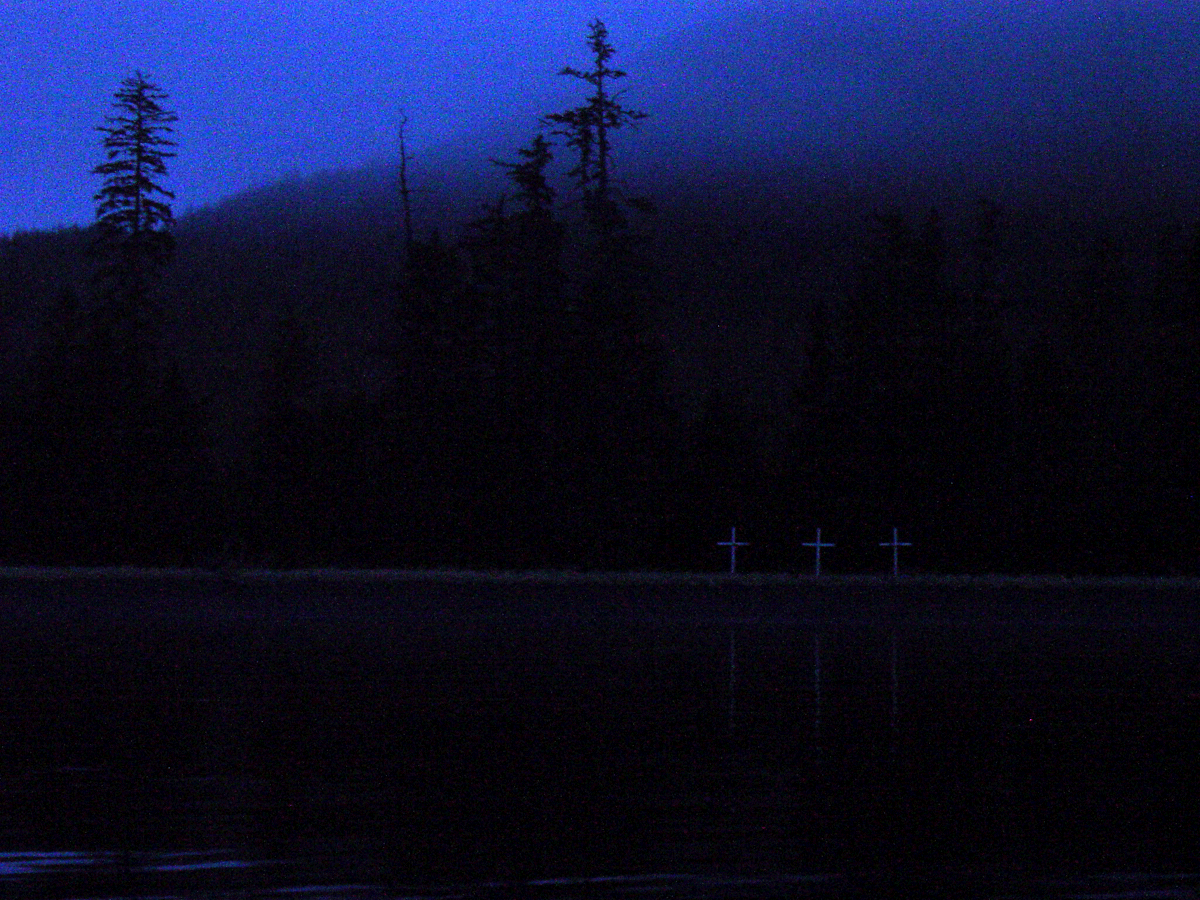
We made our way down the west coast of Kuiu Island, as far as Tebenkof Bay, fishing our way down.  We caught one in the Kingsmille area, but no more.  Trying to work our way back to reach Petersburg by Saturday evening, we fished a number of areas along the way.  Nothing.  Then, at Saginaw Bay on the Northern end of Kuiu, we fished along a sheer cliff that went straight down for another 120 fathoms underwater.  We had a nice fish, and just as Keith was landing him, the lines began to go crazy, and he remembered the warnings he’d had about the underwater reef that hooks out into the bay.  We jammed the throttle to full speed to lift the lines by our momentum, but one 45 lb lead broke off and added to the reef.  The breakaway lines we put on for that very situation did their job, saving us from broken trolling poles or worse, but a 150 dollar lead stayed behind.  Unfortunately, the lure of catching another fish in the same hole overcame good judgment, and we replaced the missing lead, dropped the gear down to 30 fathoms, and tried from the other way.  We left a lot of room where we thought the reef was, and made the approach.  We were both looking at the depth sounder display when we saw a strange, vague image appear up to 5 fathoms.  We commented that im must be seaweed growing on the old leads lost by other fishermen, when all of our lines began the dance again, and we realized the reef had suckered us in from this way also!  This time one lead broke off, and the wire on the other snapped at the boat, leaving all the gear from that line behind.  Fortunately the float bag (a Styrofoam float that keeps the outboard lines separated) was still attached, and by some tricky and heart in throat maneuvering with the tide to keep the stainless steel wire out of our prop, we hooked on to in and tried to pull it free.  We got all the gear, but one more lead bit the dust.  Calling it quits, we headed up past Kake Bay to Pinta Rocks for the night.  Leaving the reef, the tide rip was so bad a half mile offshore that we had large, chaotic 3 foot waves and a spinning current pushing us backwards at 3 knots.  Once we broke free ( a 15 minute process), we continued to the anchorage.  It was dark upon arrival, and we tentatively mad our way to the mooring grounds.  Setting the anchor, I noticed the vague forms of 3 large crosses on the beach.  I took a photo, and you may sense the loneliness of the place.  Keith told me the story of a young lady who I met later in Petersburg, who lost her brother and 2 friends in an open skiff offshore.  Only one body was ever recovered – the lonely sea and the sky…


We made our way on to Petersburg the next day, and arrived in time to catch the rushing tide up the Wrangell Narrows to the harbor.  I mentioned before that the harbor was “less than user friendly” – you should try docking a boat in the place with a tide running!  The current flows right thru the harbor, and there are even waves created at the piers just from the running water!  The first approach to the dock, Keith was driving, and suddenly we were about to smack the next boat sideways.  He was able to clear it, turn in time to make a big circle, and approached for another try.  Third time was a charm, but I had to bail off in a hurry and throw a line around a cleat to keep us from smacking the dock!  We found that slack tide was the only time to approach or leave – I got pinned to the side once and just about had a disaster upon leaving.  One day I made 4 big circles trying to get lined up straight and never did get it!  Keith took a shot at it and was able to wallow in – not pretty, but no damage—successful!

There was a distinct lack of fishermen out trolling – we saw maybe 5 different boats working in the 2 week period.  Should have told us something…..!  Still, stubbornness dictated that we give it all a sporting try rather than bail out, so we did, although we called it quits a couple of days before the end of April, rather than waste fuel.
I decided that enough was enough, and headed for Sitka on Friday afternoon.  Keith left for Montana to do some profitable roofing, and may return in July for the main summer King salmon opening.

I anchored for the night in Portage Bay in the dark, recalling the stories Larry had told the night before about the crab boat that lost a thru-hull fitting during the night at anchor there, and sunk, losing all 3 crew as they slept…  I checked my anchor a lot, and it was eerie, thinking about the incident, and seeing my anchor chain glowing down, down, 6 or 7 fathoms, with the phosphorescent glow as the tide streamed by.  I awoke at 3:30 am,  pulled anchor, and got on my way with the radar guiding me thru the fog.  I saw one boat far to my stern, which finally caught me and passed just off of Kake – the only boat I saw all day.  Talk about weirded out --  it gets a little strange, steaming along, and no sign or sound of human life, for a whole 12 hours or so!   I did manage to make contact with Eli on the Emydon (a new Petersburg friend, who guides bear hunting this time of year), somewhere in a bay on the west coast of Admiralty Island.  Just a voice in the ether, but somewhat comforting to know someone knew where I was!  

A turn around the corner into Peril Strait, and the wind hit.  I bucked a stiff chop as I entered and headed for Saook Bay, an abandoned old cannery where I planned to anchor for the night.  I was getting pretty punchy after a long day, and was ready to sleep.  I called Brad and Minnie  on the Bear, on the off chance that they were nearby.  Minnie answered, and told me their location, about 3 more hours travel.  I still had daylight, and the thought of being with friends for the night was more than I could pass up, so on I went.  Somewhere near Hoonah Sound, I saw the beautiful 50+ foot wooden boat that they live on and guide from.  I just tied up alongside, since their anchor is about as big as the Queen Mary’s, and went aboard to see how luxury lives!  Pretty fantastic boat!  If you ever want to take a sightseeing trip or bear hunt with them, your money would be well spent!  Nice quarters, knowledgeable hosts, and the best scenery and company around! 

I left the next morning much cheerier and refreshed, with good advice on managing the tides thru the Narrows.  I finally made it home(!) to Sealing Cove harbor at Sitka at about 7 pm.  Large sigh of relief!  Now, to see if I can catch fish here, by myself, or not!  That’s the next tale… stay tuned!

Sunday, April 25, 2010

Learning Curves

Well, it’s been a whirlwind of learning and experiencing, but the riches seem to be more elusive than ever! I really don’t know where to begin….
Keith arrived on April 1, and we began gearing up. A few thousand dollars later, we had enough equipment and gear to make a trial run. We headed up from Sitka to Halibut Point Marine, about a 20 minute trip, to top off the fuel tanks. 80 gallons later, we headed out into the more protected area of Sitka Sound to try out the operation of actually fishing. We didn’t expect to catch anything, so weren’t disappointed when there was no activity. We brought her back to the harbor with a nice swell abeam, and got to see how the True North rode the roller coaster. She’s a smaller boat, but takes weather like a champion.

Ready for a longer venture, we headed up to Salisbury Sound, about a 30 mile trip. At 6 knots, that takes about 5 hours. The passage up there is like a travel brochure – grand mountains, calm water, the occasional boat passing. The Sound itself was nice to fish. A little bit of choppy water with the wind blowing, then some 6 foot seas near the ocean entrance. We caught the first of what we hope to be many – a 29.4 (dressed weight) king salmon. At over 7 bucks a pound, it was worth keeping! Unfortunately, it was the only one the trip produced. Two days there, one fish. Not so hot. The maniac in the picture is dressed for the occasion in the hat provided at the farewell dinner his friends at Semitool gave… the Whackem bat, complete with customized logos, was a bit soft, but the gift was appreciated! There have been a few lonely days when I pressed the button just to hear the crowd roar, and it always brings a smile! Seriously.

Willie the wonder dog – 36 hours before he went to the bathroom. He has some sort of moral code not to go on the boat, so I finally plopped him in the Zodiac raft when we anchored the second night and rowed him to shore. No trouble doing his business there!
It was a bit of a rodeo with him all excited and trying to circle the inside of a 6 foot boat, me kneeling in the bow with a paddle, and trying to get back to the fishing boat!

Once we were confident that things were going to work mechanically as well as could be expected ( did I mention I’m a Nervous Nelly about all that can go wrong?) , we headed out with the big boys to Cape Edgecumbe and the Winter Line. The line is a boundary set by Fish and Game, beyond which it is illegal to fish. Google Earth it – from the Cape Edgecumbe light to the southernmost tip of Woodward Point on Biorka Island. It doesn’t look far, but it takes us a little over 3 hours to get out near enough to fish. The weather can get brutal very quickly – we only have had 2 days where the seas were under 8 feet, with 15 foot swells being very common. Go look at your house, and figure out how high that is – when it’s not blowing, it’s pretty neat. When the wind is howling and the chop is short, it is downright abusive. Want an ab workout? Go to sea!

We’ve fished the cape now for a couple of weeks, and keep hearing the same refrain from the other fisherman – where are all the fish? Judging from the fact that the price keeps going up and we keep catching very few, I suspect that it wouldn’t be considered red hot fishing right now. Hope we survive the cash flow problem until it gets better!

Todd and Emery came for a few days and brightened up the mix. They were loaned some electro-shock wrist bands by the Dennison’s for reducing the sea-sickness rate. The first day we took them to the Cape, we forgot the wrist bands, and found we had no Dramamine on board. Keith and I are both lucky enough to not suffer from seasickness in the least, so we sort of forgot to prepare for the less fortunate. The swells were big rollers, and not choppy, so everyone was deceived into thinking things would go well. Unfortunately, the motion when we slowed down to fish began to cause bad thoughts in Todd and then Em began to act about the same. The photo is poor Todd in the fetal position that he used to escape with, between trips to the rail to chum for fish. After a long day for them at the Cape, and 1 fish only, we decided to return to Sitka for the night. We had a hydraulic hose that was failing, and the pulse pump feed for the cook/heat stove died, so it made sense. One fish, about 90 bucks; hose – 30, pump – 100. Who’s winning here, anyway??

The following day, with electro-shock therapy on his wrist, and loaded with Dramamine, Todd headed back to sea. Em didn’t like the shocker, so she just ate the pills and toughed it out. For those who need a testimonial about the wrist gadgets, Todd’s your man. It worked—we caught another fish, then anchored for a more or less comfortable night behind St. Lazaria Island. About 40 other fishermen were working the Cape, and the anchorage was full of all sorts of craft for the evening. We caught several more fish on Saturday, and came home on a beautifully glassy sea that evening.

I sat in the door off my boat Monday morning at 6 AM, and listened to the guns, screamers, and other bird bombs go off at the airport, about a quarter of a mile from the harbor. The plane lifted off perfectly into the clear morning air, banked over Mt. Edgecumbe, and left me really, really lonely. Love my family….

Later on Monday, we had our courtesy Coast Guard inspection that gives a person an idea of whether they comply with all the rules and regulations. I had a couple of items to add to the boat, plus an emergency drill class I need to take, and otherwise things went well. We headed off to the Cape again to fish – seas were bigger, ugly, and we were one of only 6 boats out there for the day. We had the dubious distinction of being the very last boat to leave the line Monday night – Tuesday was equally rough, and devoid of fish.
After a strategic reassessment, we decided that Wednesday we would leave Sitka and head inside Chatham Strait and work our way to Petersburg to try our luck.

Sunday, April 4, 2010

We're Off!

Tales of the True North… sounds pretty much like a novel of some sort, doesn’t it?!  The reality is, it seems much that way in real life.  Here’s the story to date –

After a month of working from stem to stern on the boat, learning the systems, finding the places that needed repairing, and pouring money into the hole that a boat makes in the water, we finally have gone out for 2 days.  Keith, my fishing tutor, arrived last Thursday morning at 2 AM on the ferry from Petersburg, and we began the process of getting geared up for fishing.  We reviewed all the rigging and gear together, and went to the store to contribute yet more of the dwindling funds to the local economy.  One small shopping basket (the hand-held kind!) was over 1200 bucks, and that just got us enough stuff to make the basic sets.  This is for a bunch of odd-colored, shiny pieces of metal, gooey, bizarre-colored glow in the dark blobs of plastic with eyes, assorted hooks, lines, crimps, snaps, and a package of herring  -- the herring were the only thing that made any sense at all to me, but then, I’m not a salmon…
I was quite nervous about the maiden run, since there are so many things that can go wrong on an older boat, and I am somewhat of a Nervous Nellie.  I woke up at 4 am on Friday, worrying.  By the time we got everything lined out and ready, it was nearly 1pm, and we fired the 353 Detroit Diesel up and pulled away from the dock.  The fourth opening of the herring roe fishery opened at one just to the south of the harbor, so we went up the channel to the north to stay clear.  It was quite a zoo listening to the seiners on their final chance to get rich on herring – tempers were up, with lots of threats back and forth as they set their nets alongside each other, each jockeying for the biggest amount of fish.  Lawsuits and all sorts of legal actions will come from this one, with a couple of boats colliding, charges of deliberate ramming, and all sorts of lesser evils occurring. 
We got clear of the harbors with our trolling poles up, and the boat began to roll in the swell.  We have 35 foot aluminum poles, along with a 25 foot aluminum mast sticking straight up, so the boat rolls a bit with them straight up.  Once we lowered them to their 45 degree position, the roll slowed a bit.  When we put the stabilizers in the water, it was solid as a rock.  Stabilizers are 2 foot wide pieces of wood with a lead weight, that hang from a chain located about midway out the pole.  They ride 20 feet or so down into the water, and provide a resistance to the rolling motion of the boat.  Willie, the Labrador, was a bit disconcerted by the motion of the boat.  He stayed out on deck, looking rather forlorn for most of the trip!  We made it up to the fuel dock at Halibut Point, about 45 minutes after leaving and put 80 gallons in the tanks.  We then headed around some of the inside islands, and put the fishing gear in the water.  It takes about an hour to get it all out, and then we trolled for a couple of hours, just checking things out.  No fish, but we learned a lot about the boat’s behavior.   
By the time we decided to come home, we realized we didn’t have a great deal of margin on the daylight factor, which is not real smart on the first run of a boat!  We came back in thru the middle part of the Sound, and got some of the larger swells abeam.  The little boat just purred along, with a great ride.  I slept better that night!

On Saturday, we decided to head out toward Cape Edgecumbe, where the good fishing is.  We left the dock around 8 am, and went over to Sitka Sound Seafoods, one of the main fish processing facilities here, and had about 1000 pounds of ice pumped into our fish hold.  We figured it would give us a little more ballast, as well as preserve any fish that we might catch.  There was a breeze blowing, and I had to make to passes at tying up to the pilings before I got it.  Being the new kid in town, I was pretty self-conscious about it, but made it happen, and we got our ice. We jockeyed our way out of the main harbor around little hand trollers, big tenders, big herring seiners, the huge Fish and Game boat (Kestrel), as well as a float plane taxiing down the channel to take off.  Once we cleared the congestion, the poles came down with the stabilizers, and we headed southwest toward the Sound.   Waves were 4-6 feet as we rounded the end of the runway for the airport on Japonski Island, and we headed straight into them to get out to a fishing area.  About an hour later, we were clear of Surf Rock, looking back at the impressive power of the water breaking over the rocks, so we began putting gear in the water.  As time wore on, the waves grew, as did the breeze.  We passed one, then two, then three bigger trollers heading the opposite direction, back to the harbors.   

Once the gear was all set, Keith came in to warm up.  We ran this way for about an hour, with the waves steadily growing, as well as the choppy surface generated by the wind.  Forecast was for 20 knot winds with seas 4-6 feet.  We began encountering steady 10 foot seas with gusts to 30 or so.  As time went by, more trollers passed, all with gear onboard and heading for home.  When the seas began to hit 15 feet occasionally, and still no sign of fish, we decided to join the crowd and head for home.  We turned with the seas and wind coming over our starboard stern, and Keith was once again banished to the trolling pit to pull gear aboard.  I tried to keep a steady course, which was a bit difficult.  The sound of waves breaking behind the boat, and gaining on us was not uncommon.  We had the deck washed off nicely by a couple that broke on the side, but by and large, the little vessel handled like a dream!  The engine ran well, the equipment worked, and the ride was nice.  It’s been a lot of years since I looked out the back door of a pilot house and saw 15 feet of windswept water bearing down on me!  We made it back with no further ado, and even got checked out by an Alaskan State Trooper when we got docked.  Nice young man, very helpful.  Today is our day off – tomorrow we hope to head North up the inside channel and fish for a couple of days before Em and Todd arrive on Wednesday.  And that’s the beginning….!

Tuesday, March 23, 2010

Needed -- Noah

Well, as a famous Midwest radio show host says, "It's been a long week.." in Sitka.
A word to the wise -- when you read Average Annual Rainfall figures for this part of the world, it all is just numbers, until you sit for 3 weeks with the pitter-patter drumming overhead. We go from rain to rain and wind to rain and snow to rain and wind and snow. Every 4 or 5 days, there is cloudy, and at least twice I have seen the sunshine! It is gorgeous when that occurs, but the locals assure me that won’t last long!
The progress has seemed glacial, but looking at the state of things today, I feel encouraged. I feel like I know the electrical system pretty well; I’ve wiped the engine down by hand and checked the belts, hoses, and other systems in depth; the paperwork is slowly trickling in, and Keith is due to arrive in a little over a week. Once he’s here, we outfit the actual fishing gear part of the vessel, and give it all a tentative test run. Hopefully, there will be at least one fish to sell in the course of the next couple of weeks! I’m starting to get antsy about income – all the money is flowing in an outward direction, and the bottom of the purse is in sight!
The big news this week is HERRING! The Sitka Sound herring roe fishery is on 2-hour standby from the Fish and Game department, meaning they get a two hour warning before their season opens. This is critical since the season only lasts 15 minutes – not a second more! There are 49 permits for this fishery (so I’m told) and boats are limited to somewhere just short of 60 feet (again, so I’m told). Average income per boat is around $200,000 for the opening… record catch last year put one guy over 1.5 million for his set! Somehow, I don’t think salmon trolling is going to get anywhere close! You can see the beautiful, perfectly equipped seiners in the harbors now, and there is an excitement everywhere you go over the pending opening. Stores and bars are doing very well right now! I took a shot of one of the harbors Saturday night, and you can see all the big rigging on the seiners clustered up with Mount Edgecumbe as a backdrop. There are over 1300 boats harbored here, and the seiner fleet has added to the congestion.
Willie has adjusted well – he took over the bunk that I will use when Keith comes, so we may have to argue a bit over possession! He wakes me up wanting to go play and do his business, so we head up the dock pretty early. He fell off the dock while tied to the boat a week or so ago – I’ve taken him swimming in the ocean on the weekends when he doesn’t have to dry out on the boat – Rich lets him sleep in the warm garage on Saturday nights. These folks have taken such good care of us that I am humbled. Not sure how I will ever repay…. Thanks is all I can say for now.
Well, I better do something physical – this is too much like the life I left, spending time on the computer! Somehow, my hands don’t look the part anymore…

Thursday, February 4, 2010

Phase II - the big Leap

For those of you who followed our return to the sea last summer, and recognized the hopelessly ecstatic expressions on our faces, it will come as no surprise to find not a scaling down of the Alaskan fishing fever, but rather a full-scale leap off the cliff of all that's "normal" in our lives. In the months since our last post at the Something Fishy blog we have traveled several thousand miles, spent way too much money, met a lot of great and helpful people, and finally are within the last stages of buying a boat and permit of our own. I hesitate to post pictures and make too many statements before those final papers all are signed, so you'll have to stay tuned to see the boat and the plan. It is serious enough that I've quit my job of 17 and a half years and joined the ranks of the self-employed, unfortunately with minimal income so far! If that isn't commitment, please tell me what more I should do!
This blog is to work hand in hand with the website I'm developing for the business, www.BeelinesAK.com . That site will provide pictures, overview (and some details) of the business, including any marketing arrangements we make, etc. This site is more for those who wish to follow the path thru the sea from afar, listen to my ramblings, and generally get to know us a little better in the journey.
I read recently that "Adventures are a logical and reliable result ....... of the fatal act of leaving one's home, or trying to return to it again." Well said. Here we go!